日志
英国瓷场 之 百年老店斯波德
热度 5 |
2020-10-30
天下没有不散的宴席,世上没有不倒的强权。2009年,曾经以发明了骨瓷而闻名于世,并辉煌了238年之久的大英帝国斯波德(SPODE,1770-2008)瓷器工厂因金融危机轰然倒地,寿终正寝。为这一历史事件画上完满句号的,是斯波德文化遗产基金会的建立和斯波德博物馆的诞生,以及斯波德瓷器脸书网页的开通(https://www.facebook.com/SpodeUK/videos/594772754042452/)。如果该瓷器工厂晚五年停业,碰上了人傻钱多的大陆接盘侠,也许会有完全不一样的命运,不过这是后话。
Josiah Spode (1733–1797) was an English potter and the founder of the English Spode pottery works which became famous for the high quality of its wares. He is often credited with the establishment of blue underglaze transfer printing in Staffordshire in 1781–84, and with the definition and introduction in c. 1789–91 of the improved formula for bone china (a form of soft-paste porcelain) which thereafter remained the standard for all English wares of this kind.

- In “A View of the Staffordshire Potteries”printed in 1800 by Thomas Allbut, Stoke-upon-Trent was described as “a pleasant rural place, and contains some handsome buildings. It has many earthenware manufactories, some of which are upon an extensive scale.” It was in these environs that Josiah Spode grew up and began his illustrious pottery.
- Since the closure of the Spode factory, the Spode Museum Trust's collection has been in storage. The temporary visitor centre has been set up so that people can access the collection and so that we can find out the experience of former workers at Spode and collect their reminiscences and photos to add to the permanent archive.
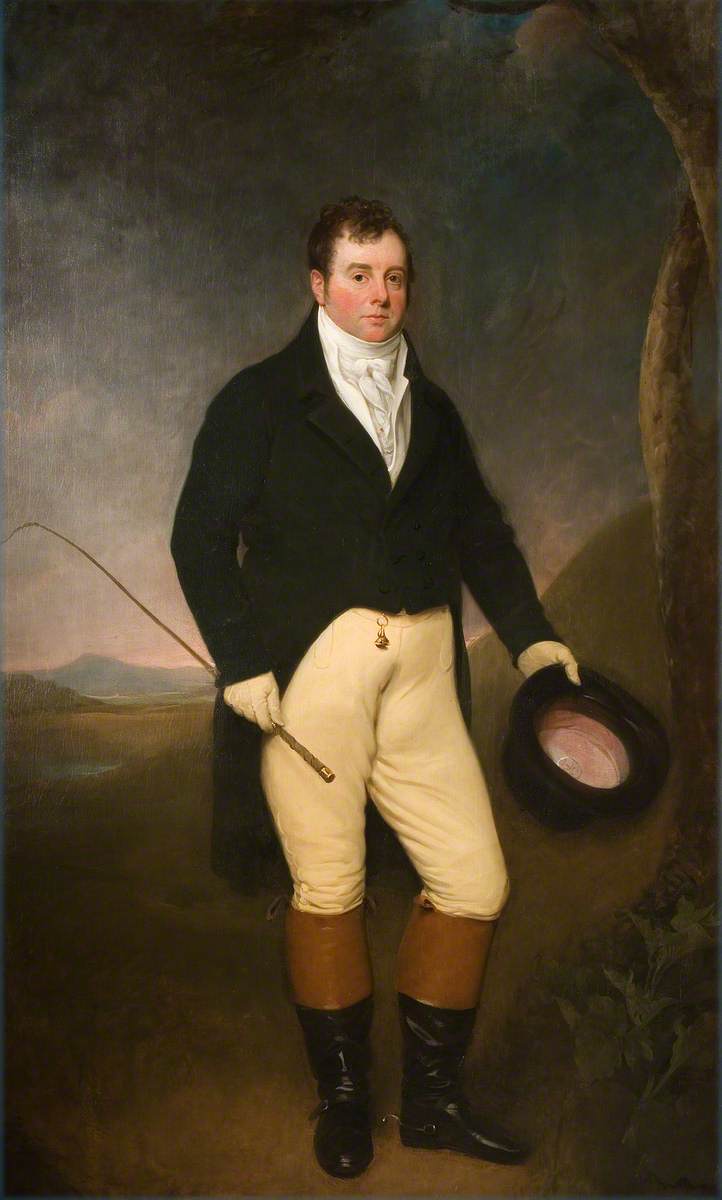
斯波德二世 - Josiah Spode II (1755-1827) was the eldest of 8 children born to Josiah Spode I (1733-1797) founder of the Spode company.
自古商人都靠偷,无商不偷。早期的斯波德,仿制的是中国的康熙瓷:对这一点,斯波德博物馆盖棺论定,直言不讳,坚决承认:
- In the late 1700s and early 1800s Spode made pieces to match and/or extend existing Chinese porcelain dinner services owned by the well-to-do at a time when it became more and more difficult to obtain porcelain from China. These designs gradually infiltrated Spode's production of both traditional and new designs. The Chinese style was constantly reworked and revived at Spode during 220 years of production; right up to the early 2000s when, ironically, the company began to have their product made in China.
斯波德仿制的骨瓷粉彩牡丹孔雀盘 - On the left is a Chinese porcelain original and on the right is a Spode copy in Stone China c.1815. The pattern, number 2118, became known as Peacock, and was immensely successful, being reproduced in numerous versions on various ceramic bodies by Spode throughout the nineteenth and twentieth centuries.

偷久了,自然就成精了,有自己的创新和独特的风格了。柳树和玫瑰,是斯波德最为得意的两件作品。
斯波德收藏中的康熙柳树瓷盘在维多利亚博物馆和瓷都艺术博物馆里的维利柳树青花盘,有明显的纪年款 - The Willow pattern is one of the most famous British ceramic designs. The scene of a temple with bridge, boat and willow tree was inspired by images found on Chinese ceramics, but was the creation of British manufacturers in the late-18th century. The love story it supposedly depicts was invented later as a clever marketing tool. An early dated example of the Willow pattern design is in the V&A collection, a plate inscribed ‘Thomasine Willey / 1818’ . The Willey family of Cornwall, for whom this plate was made, supplied the Staffordshire potteries with the blue pigment, cobalt, in the early-19th century.


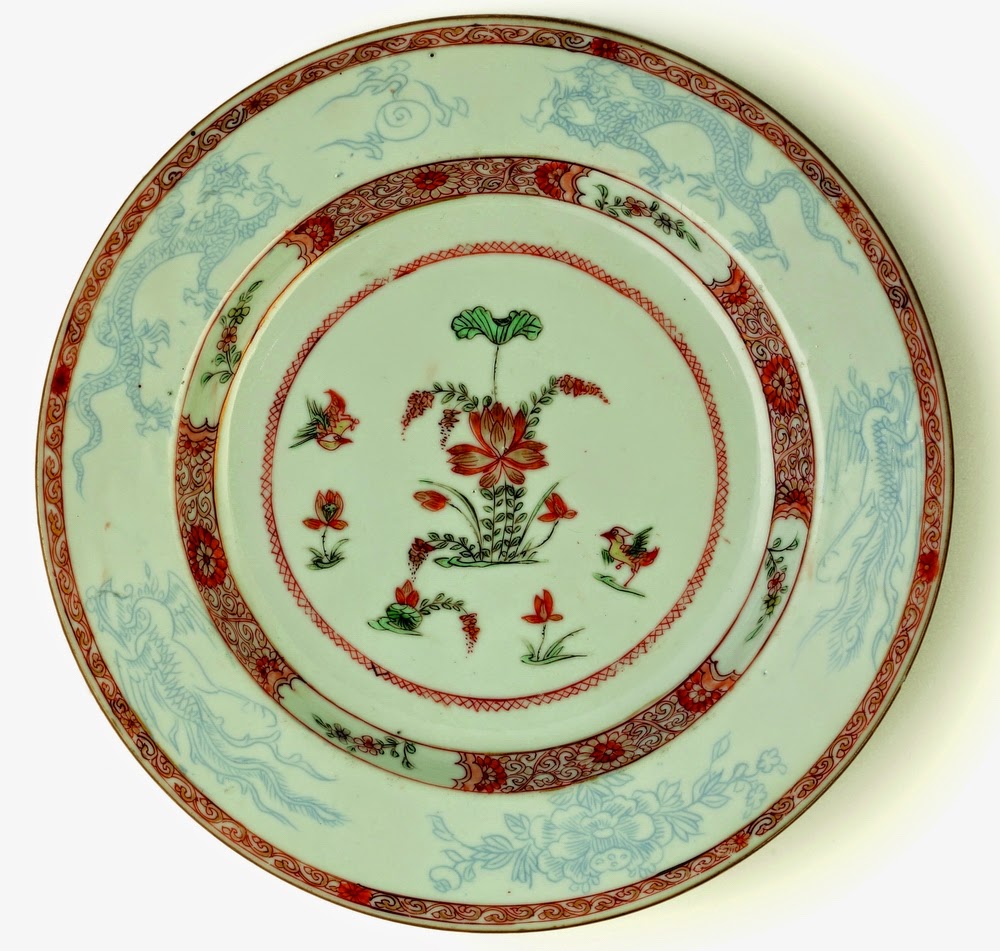
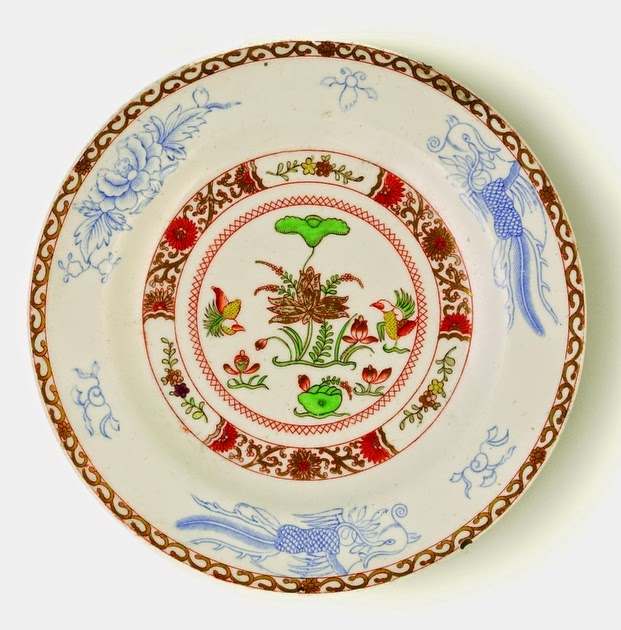
十九世纪早期由于欧洲中国瓷器热的迅速降温,斯波德瓷器厂很快找到自己独特的设计风格和商业增长点,意大利蓝和东方次亚大陆的野外运动,再次领导时代新潮。斯波德剽窃中国瓷器柳树式样的商业行为,由于夏洛特女王的一次视察而被赋予了新的含义。During the visit Queen Charlotte ordered a service in the newly invented Stone China. The pattern was almost certainly in the Chinese style as Spode II's newly invented Stone China was intended to imitate Chinese porcelain. The description of this beautiful ceramic body is included in this report and says It resembles India [ie Chinese] China so closely that it is with difficulty the difference can be discovered. Spode's Stone China was such a success it was in production until the 1990s.康熙-雍正时期的中国景德镇瓷盘:Chinese Porcelain plate, 22.6cm c1720-1730 - Porcelain plate with floral sprays and birds. Gold, red and green enamels surrounded by a panelled and diaper border. Underglaze light blue dragons, qilins, flaming pearls and flowers on the rim. Gold around the rim. Copper red floral motif on the exterior of the plate. The source of Spode's pattern number 2638.1818年烧制的斯波德骨瓷瓷盘(Spode bone china plate, pattern 2638, 21cm c1818)- Many English designs can be traced back to chinese prototypes. Chinese porcelains had long served as the ideal for all British potters and greatly influenced the industry of the late 18th and early 19th centuries. Spode was amongst a number of manufacturers who responded particularly strongly to these Chinese influences.

- With the influence of Chinese porcelain fading fast in the early 19th century, manufacturers of printed earthenware needed fresh design sources. Popular prints seemed ideal for popular tablewares, and with the publication in 1807 of Captain Thomas Williamson's Oriental Field Sports, Wild Sports of the East illustrated by Samuel Howitt (previously issued from 1805 in 20 monthly instalments), the Spode factory found a perfect new source. The great success of this series of prints on Spode tableware led to other manufacturers copying the same designs, which were free of copyright restrictions.

- One of Spode's most famous patterns, the Italian pattern, also known as Blue Italian and Spode’s Italian, was introduced by Spode in about 1816. The design was immediately popular and remained a best seller. Over the years it was produced on a wide variety of shapes in earthenware. It was in continuous production up to the closure of the factory in 2009.
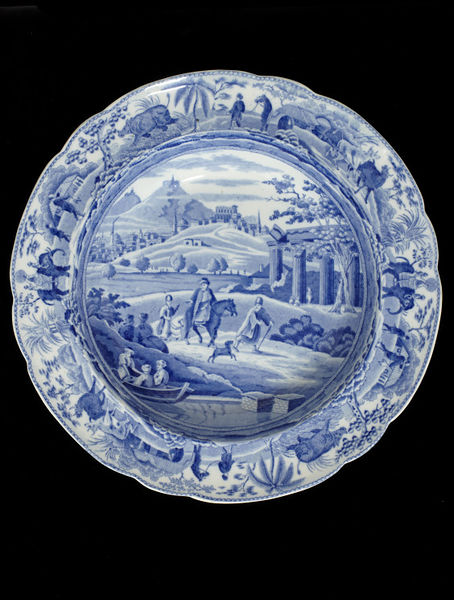
- The 'City of Corinth' is from the Spode 'Caramanian' series. The border is derived from plates in Captain Thomas Williamson's 'Oriental Field Sports' (1805-1897). The main scene is taken from engravings in Luigi Mayer's 'Views in Egypt, Palestine and the Ottoman Empire' (1801-1804).Spode's Caramanian Series patterns are not named on the pieces themselves; the names are derived from their source prints. Caramania refers to the ancient name for an area on the southern coast of Turkey now known as the "turquoise coast". Spode also issued several variations on the patterns. The series was first produced c. 1809. The border figures for the Caramanian Series come from illustrations by Samuel Howitt in "Oriental Field Sports", published in 1807. That book was the source for the border and central scenes of Spode's Indian Sporting Series, which was copied by other makers. The animals on the border are different for each of the two series. For extensive material on both of these series, see Williams1943 and DrakardHoldway1983. Illustrated in Coysh 1970 p. 73, #88; and in DrakardHoldway 1983, p. 162, and DrakardHoldway 2002, p.245 (P905-13).
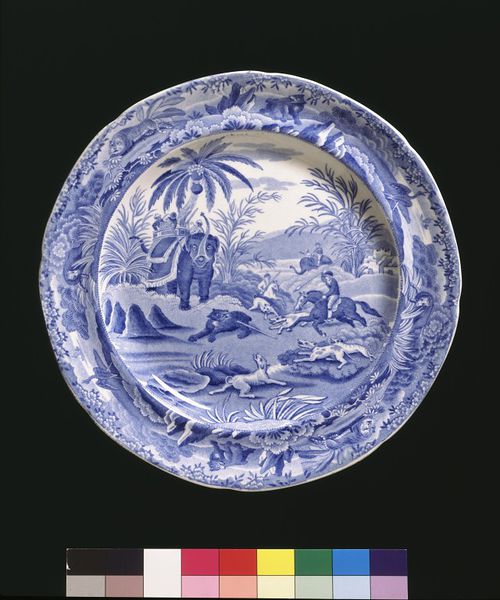
- The British had been vigorously extending their power and influence in India since the mid-18th century, and after peace was restored in Europe in 1815 following the decisive battle of Waterloo, public interest began to turn once more towards the expanding British Empire. Prints such these, which derived from 'on the spot' drawings by British artists and soldiers living in India, and which showed both British and Indian sportsmen hunting game together, did much to stimulate curiosity about the sub-continent and its cultural life.


全部作者的其他最新日志
- • 西方爱情诗选 之 我思故我爱
- • 从文自传 之 湘西儒将
- • 千年世家 之 神仙打架
- • 从文自传 之 杀人
- • 灯下漫笔 之 河南匪气
- • 租界里的杂文 之 募捐