The U.S. Once Helped China Develop A Modern Jet Fighter美国曾助力中国研制一款现代化喷气式战斗机作者 / Author: Thomas Newdick · 发布日期 / Date: April 29, 2021 · 来源 / Source: The War Zone (TWZ), thedrive.com
文章总结 · Article SummaryThis article from The War Zone recounts how, during the 1980s, the U.S. defense giant Grumman partnered with China under the U.S. Air Force's "Peace Pearl" program to modernize the Shenyang J-8II interceptor with Western avionics - the Westinghouse AN/APG-66 radar, head-up displays, inertial navigation, and more. Two airframes were shipped to the United States for testing in 1989. The cooperation collapsed after the 1989 embargoes; China ultimately completed only around 60 J-8IIs without U.S. equipment, later turning to Russia and Israel for advanced avionics. The piece reflects on what a "Shenyang-Grumman" fighter might have become.
本文来自 The War Zone,回顾了 1980 年代美国国防巨头格鲁曼如何在美国空军“和平珍珠”(Peace Pearl)计划下与中国合作,用西方航电——西屋 AN/APG-66 雷达、平视显示器、惯性导航等——升级沈阳歼-8II 截击机。两架机体于 1989 年运抵美国测试。1989 年禁运后合作中止;中国最终仅完成了约 60 架未使用美制设备的歼-8II,并转而求助于俄罗斯与以色列发展先进航电。文章畅想了“沈阳-格鲁曼”战斗机本可能成为的样子。
Today, with the Chinese People’s Liberation Army Air Force’s ranks getting filled with indigenous J-10 multirole fighters , as well as increasing numbers of J-20 stealth fighters , the older Shenyang J-8 Finback fighter jet is increasingly a relic of a bygone era for the service. While the domestically-produced J-8 was built in multiple versions, the Chinese had already supplemented it with Russian-made Su-27 Flankers as soon as they could. However, for a time, the story of the mighty Finback looked set to be very different, thanks to the involvement of the U.S. defense giant Grumman.
如今,随着中国空军(PLAAF)的机队逐渐充实以国产歼-10多用途战斗机以及数量不断增加的歼-20隐身战斗机,较为老旧的沈阳歼-8“长须鲸”(Finback)战斗机对该军种而言正日益成为上一个时代的遗物。虽说国产歼-8曾发展出多个型号,但中国人一旦有条件,便已用俄制苏-27“侧卫”(Flanker)对其进行了补充。然而,曾有一段时间,这型强大“长须鲸”的故事本可能走向完全不同的方向——这要归功于美国国防巨头格鲁曼(Grumman)的介入。
The story of Grumman’s involvement in the Chinese J-8 fighter program dates back to the normalization of Sino-U.S. relations back in 1979. That year, the U.S. government recognized Beijing, and not Taipei, as the legitimate Chinese capital, and a new period of diplomatic and trade relationships was established. This new reality also impacted the global arms market and China began purchasing weapons from U.S. firms, with official State Department approval. It’s for this reason that, even today, the People’s Liberation Army still operates a number of Sikorsky S-70 Black Hawk utility helicopters, for example.
格鲁曼参与中国歼-8战斗机项目的故事,可追溯到1979年中美关系正常化。那一年,美国政府承认北京而非台北为中国合法首都,一段全新的外交与贸易关系时期由此开启。这一新局面也冲击了全球军火市场,中国开始在国务院正式批准下从美国企业采购武器。也正因如此,即便时至今日,人民解放军仍在使用一定数量的西科斯基S-70“黑鹰”通用直升机。
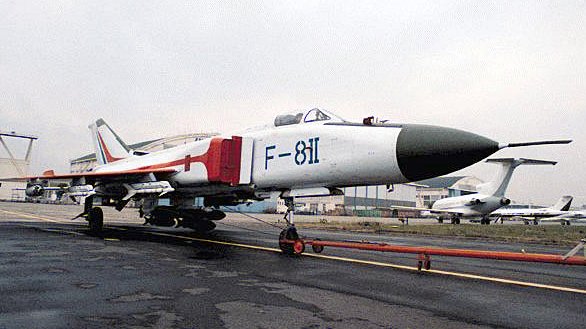 A prototype J-8II marked up as the F-8II for export., U.S. DEPARTMENT OF DEFENSE一架以出口型F-8II名义标识的歼-8II原型机。(美国国防部)
With Beijing now able to buy U.S. arms and benefit from its technological expertise, the People’s Liberation Army Air Force (PLAAF) had the chance to change the fortunes of its J-8 fighter. The jet’s development had been extremely protracted, consistently hampered by the effects of Mao’s Cultural Revolution.
随着北京如今能够购买美制武器并受益于其技术专长,中国空军(PLAAF)获得了改变歼-8战斗机命运的机会。该机的发展过程极其漫长,且持续受到毛泽东“文化大革命”影响的拖累。
The Shenyang J-8 had begun life back in the early 1960s as a project for a long-range, high-altitude interceptor. Conceptually it would be a scaled-up, twin-engine development of the J-7, which was the Chinese version of the prolific Soviet-designed MiG-21 Fishbed . Although design work began as early as 1964, and a prototype first flew in 1969, it wasn’t until the mid-1980s that the production-optimized J-8I was actually ready to be delivered to the People’s Liberation Army Air Force (PLAAF). By then, the aircraft was seriously outdated and only 100 were completed.
沈阳歼-8最早起步于1960年代初,是一个远程、高空截击机项目。从概念上讲,它是歼-7的放大型双发发展型号——而歼-7正是苏联设计的米格-21“鱼窝”(Fishbed)的中国版本。尽管设计工作早在1964年便已展开,原型机也于1969年首飞,但直到1980年代中期货量优化的歼-8I才真正准备好交付中国空军。到那时,该机已严重过时,且仅完成了100架。
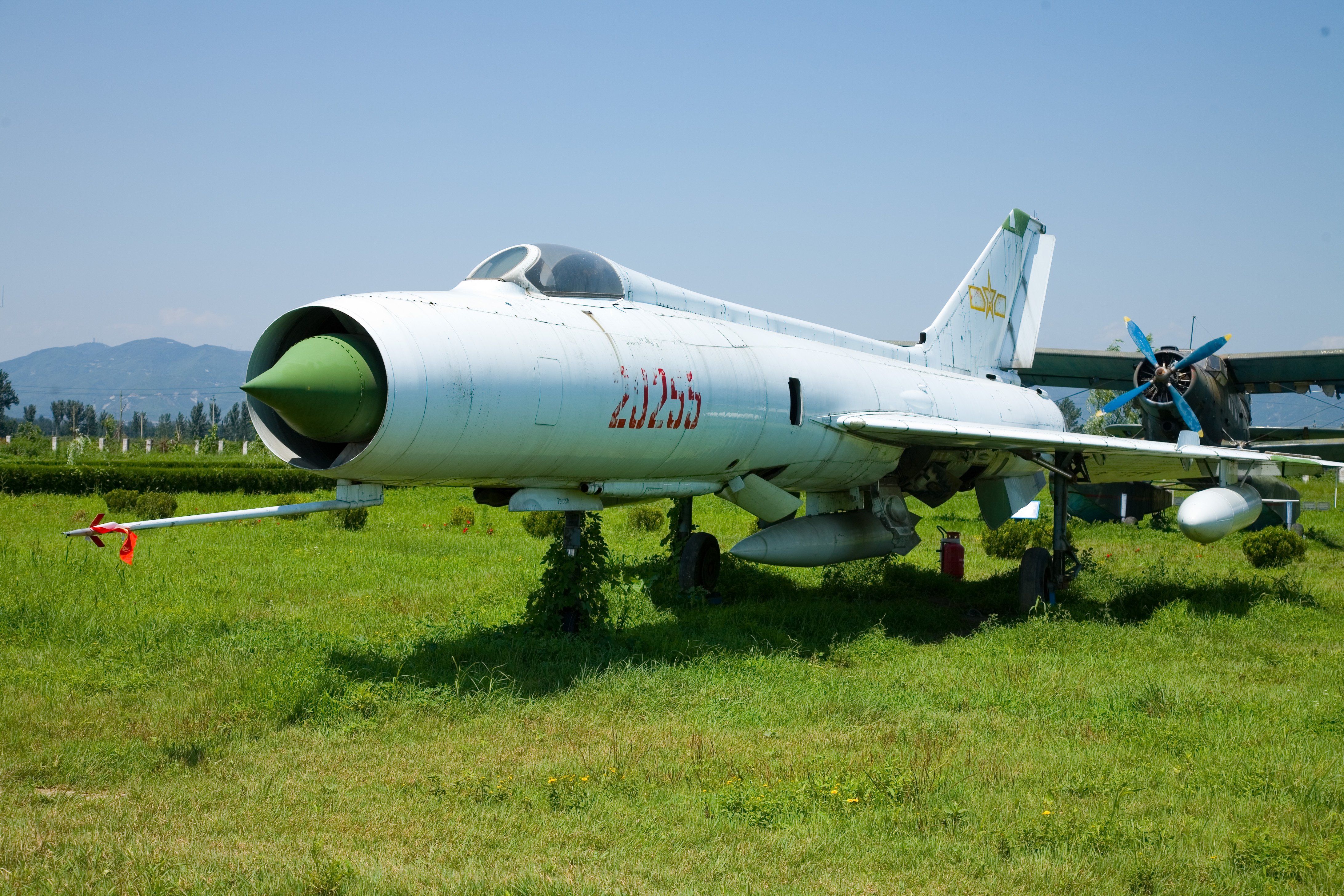 One of the first-generation J-8s preserved in an aviation museum outside Beijing., Max Smith/Wikimedia Commons保存在北京郊外一座航空博物馆中的一架第一代歼-8。(Max Smith / 维基共享资源)
Work on the second-generation J-8II, also known as the J-8B, began in 1980 and was a major redesign of the original aircraft. The J-8II featured side-mounted engine intakes instead of the MiG-21-style nose intake on the J-8I, allowing for a large radar to be fitted in the forward fuselage. There are suggestions that some of the design features were inspired by the Soviet-made MiG-23 Flogger , a handful of which were acquired by China from Egypt for evaluation, at least one of which might have ended up preserved on the former Soviet aircraft carrier Minsk .
第二代歼-8II(亦称歼-8B)的研制始于1980年,是对原机的一次重大重新设计。歼-8II采用了两侧进气道,而非歼-8I上米格-21式的机头进气,从而可在前机身安装一部大型雷达。有说法称,其部分设计特征受到苏制米格-23“鞭挞者”(Flogger)的启发——中国曾从埃及购得少量该机用于评估,其中至少一架后来可能被保存在前苏联航母“明斯克”号上。
The J-8II was first flown in June 1984 and, while offering an advantage over the fairly basic J-8I, it was still hampered by the limitations of available Chinese avionics, which lagged behind those found in Western and Soviet fighters. As such, the PLAAF was reluctant to place orders.
歼-8II于1984年6月首飞。尽管相比相当基础的歼-8I有所进步,但它仍受限于当时中国国产航电的不足——其水平落后于西方和苏联战斗机。正因如此,中国空军并不情愿下订单。
It was during J-8II flight testing that Beijing began to look to the United States for assistance in making its fighter a more modern proposition. A formal military assistance program, overseen by the U.S. Air Force and nicknamed Peace Pearl, was subsequently initiated. The Air Force has long used two-word nicknames starting with the first word “Peace” for foreign military assistance projects, typically involving the facilitation of the delivery of American-made aircraft.
正是在歼-8II试飞期间,北京开始向美国寻求援助,以让其战斗机更具现代化气息。随后启动了一个由美国空军监督、代号为“和平珍珠”(Peace Pearl)的正式军事援助计划。长期以来,美国空军惯用以“Peace”开头的两个词作为对外军事援助项目的代号,通常涉及促成美制飞机的交付。
In August 1987, the U.S. Air Force’s Aeronautical Systems Division placed a contract with Grumman to provide avionics upgrades for a number of J-8II fighters, between 50 and 55, depending on the source, worth a reported $502 million. The package was based around the same Westinghouse AN/APG-66 radar found on early F-16s . Also included were U.S.-made inertial navigation systems, head-up displays (HUD) , multi-function cockpit displays, computers, and ejection seats. Accompanied by around 40 Chinese military officers, two of the jets were transported to the United States for tests in early 1989, where they were planned to be flown by U.S. pilots. At this time, the manufacture of the 50th jet was expected to be completed in 1995.
1987年8月,美国空军航空系统部与格鲁曼签订合同,为50至55架(各来源说法不一)歼-8II战斗机提供航电升级,据称价值5.02亿美元。该方案以早期F-16所装的西屋AN/APG-66雷达为核心。还包括美制惯性导航系统、平视显示器(HUD)、多功能座舱显示器、计算机及弹射座椅。在两架战机于1989年初运抵美国进行测试时,约有40名中国军官随行,计划由美国飞行员试飞。当时预计第50架战机的制造将于1995年完成。
 The Westinghouse AN/APG-66 pulse-Doppler radar., Daderot/Wikimedia Commons西屋AN/APG-66脉冲多普勒雷达。(Daderot / 维基共享资源)
While the avionics were to be supplied by the United States, weapons were the responsibility of the Italian defense industry, in the form of the Alenia Aspide , a beyond-visual-range missile, based on the AIM-7E Sparrow , with semi-active radar homing. A batch of Aspide missiles was delivered to China in the mid-1980s, where the design was further developed for surface-launched and air-launched applications.
航电由美国提供,而武器则归意大利国防工业负责,具体为阿莱尼亚“阿斯派德”(Alenia Aspide)超视距导弹——该弹基于AIM-7E“麻雀”,采用半主动雷达制导。一批“阿斯派德”导弹于1980年代中期交付中国,中方随后进一步将其发展为地面发射与空中发射两种用途。
Prototype installations were planned for two J-8lls (presumably those that were shipped to the United States for trials), which were to have been delivered to Edwards Air Force Base, or perhaps nearby Mojave Air and Space Port , in California, sometime in 1989.
两架歼-8II(推测即运美试验的那两架)原计划进行原型装配,拟于1989年某时交付加利福尼亚的爱德华兹空军基地,或附近的莫哈韦航空航天港。
At least one photo, seen at the top of this page, shows one of the J-8IIs in an anechoic chamber in the United States. These chambers , which deaden ambient electromagnetic radiation, are routinely used when integrating new radars and other electronic equipment onto aircraft, ensuring that the various emissions don’t interact negatively with other onboard systems.
本页顶部至少可见一张照片,显示其中一架歼-8II在美国的微波暗室中。这类暗室可屏蔽环境电磁辐射,通常用于将新雷达及其他电子设备集成到飞机上时,确保各种辐射不会与机上其他系统产生不良互扰。
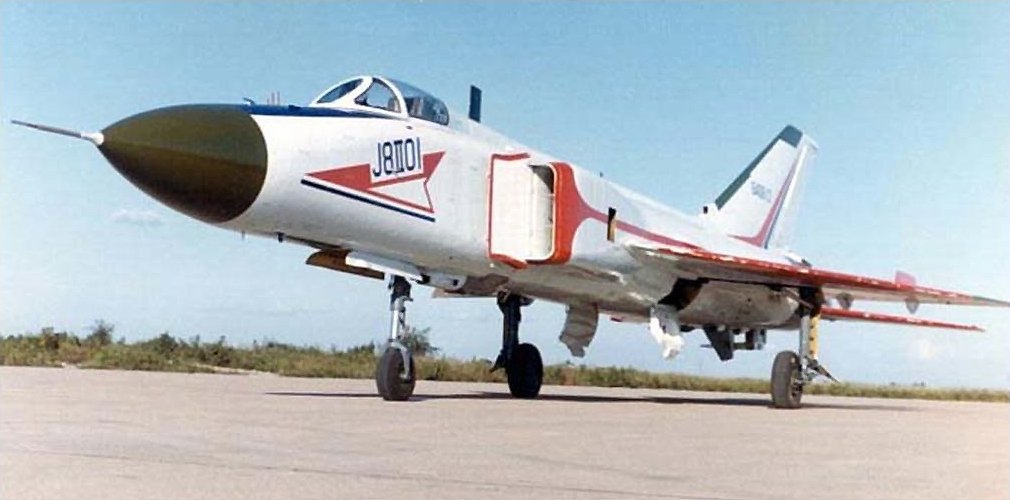 The first prototype J-8II. , U.S. DEPARTMENT OF DEFENSE歼-8II的首架原型机。(美国国防部)
There are also reports of engine tests and ground tests at Grumman’s famous plant at Bethpage, New York, but no confirmed record exists of any test flights of the upgraded aircraft in the United States.
也有报道称在格鲁曼位于纽约贝思佩奇(Bethpage)的著名工厂进行了发动机与地面测试,但并无确凿记录显示该升级后的飞机曾在美国进行过试飞。
An export version of the Peace Pearl upgraded J-8II was also developed, as the Shenyang F-8II, which was put on display at the 1989 Paris Air Show. Compared to the version of the jet being built for the PLAAF, these would have differed in having non-American avionics and weapons. The example exhibited in Paris was loaded with inert Chinese ordnance, as well.
“和平珍珠”升级版歼-8II还发展出了一个出口型号,即沈阳F-8II,并在1989年巴黎航展上展出。与为中国空军生产的版本相比,这些出口型的不同之处在于采用非美制航电与武器。在巴黎展出的那架也挂载了惰性的中国弹药。
However, once tanks rolled into Tiananmen Square in June 1989, Chinese cooperation with companies in the United States, and in many other nations, came to an abrupt end, with arms embargoes and sanctions rapidly placed on China by the U.S. government and the European Union. The U.S. arms embargo was enacted into law, effectively prohibiting the sale of all military items — lethal and nonlethal — on the U.S. Munitions List to China. Official confirmation of the cancelation of the Peace Pearl program came in May 1990 and the two unfinished airframes in the United States were returned to China.
然而,1989年6月后,中国与美方及许多其他国家企业的合作戛然而止,美国政府与欧盟迅速对中国实施武器禁运与制裁。美国的武器禁运被写入法律,实质上禁止向中国出售美国军品清单上的所有军事物品——无论致命与否。1990年5月,“和平珍珠”计划取消的消息得到官方确认,留在美国的两架未完成机体被运返中国。
Ultimately, only around 60 examples of the J-8II were completed, between 1992 and 1995 — all without U.S. equipment.
最终,歼-8II仅在1992至1995年间完成了约60架——全部未使用美国设备。
 The People’s Liberation Army Navy J-8II involved in a collision with a U.S. Navy EP-3E Aries II intelligence-gathering aircraft over Hainan Island in April 2001., U.S. DEPARTMENT OF DEFENSE2001年4月在海南岛附近与美国海军EP-3E“白羊座II”侦察机相撞的中国海军航空兵歼-8II。(美国国防部)
For successive, improved versions of the Finback during the mid-to-late 1990s, China instead turned to Russia and Israel for assistance in developing advanced avionics suites. Another key focus was on improved radars that could be used with more modern air-to-air missiles, adding a beyond-visual-range capability to the jets. The main missile in question was the indigenous PL-11 , which used a seeker based on that of the aforementioned Aspide.
在1990年代中后期“长须鲸”的后续改进型上,中国转而求助于俄罗斯与以色列,以发展先进航电套件。另一关键方向是改进雷达,以配合更现代化的空对空导弹,为战机增添超视距作战能力。其中主要导弹为国产PL-11,其导引头基于前述“阿斯派德”。
There are also rumors that the Type 1471 pulse-Doppler radar was based on the Israeli Elta EL/M-2034, while the PL-8 missile is clearly derived conceptually from the Israeli Python 3 . There was also an export-optimized F-8IIM offered with the Russian Phazotron Zhuk radar and Russian armament.
还有传言称,1471型脉冲多普勒雷达基于以色列Elta EL/M-2034,而PL-8导弹在概念上明显衍生自以色列“怪蛇3”(Python 3)。此外还曾推出优化出口的F-8IIM,配备俄罗斯法佐特龙“甲虫”(Phazotron Zhuk)雷达及俄制武器。
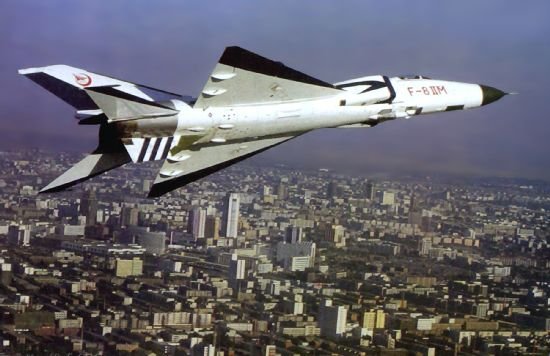 A poor-quality but rare image of the F-8IIM., San Diego Air and Space Museum Archive一张画质不佳但十分罕见的F-8IIM照片。(圣迭戈航空航天博物馆档案)
The final and most advanced Finback fighter variant, the J-8F, took to the air in 2000, finally adding a modern glass cockpit with a HUD, as well as a new and more powerful radar. Once the production of fighter models had ceased, Shenyang continued to produce small numbers of specialist versions for suppression of enemy air defenses (SEAD) and tactical reconnaissance. Today, a handful of PLAAF units still fly late-model J-8s, as well as a single People’s Liberation Army Navy regiment.
“长须鲸”最终也是最先进的型号——歼-8F于2000年升空,终于加装了带平视显示器的现代玻璃座舱,以及一部更新、更强大的雷达。战斗机型号停产之后,沈阳继续小批量生产用于压制敌防空(SEAD)与战术侦察的专用型号。如今,仍有少数中国空军部队以及一支海军航空兵团在飞行后期型歼-8。
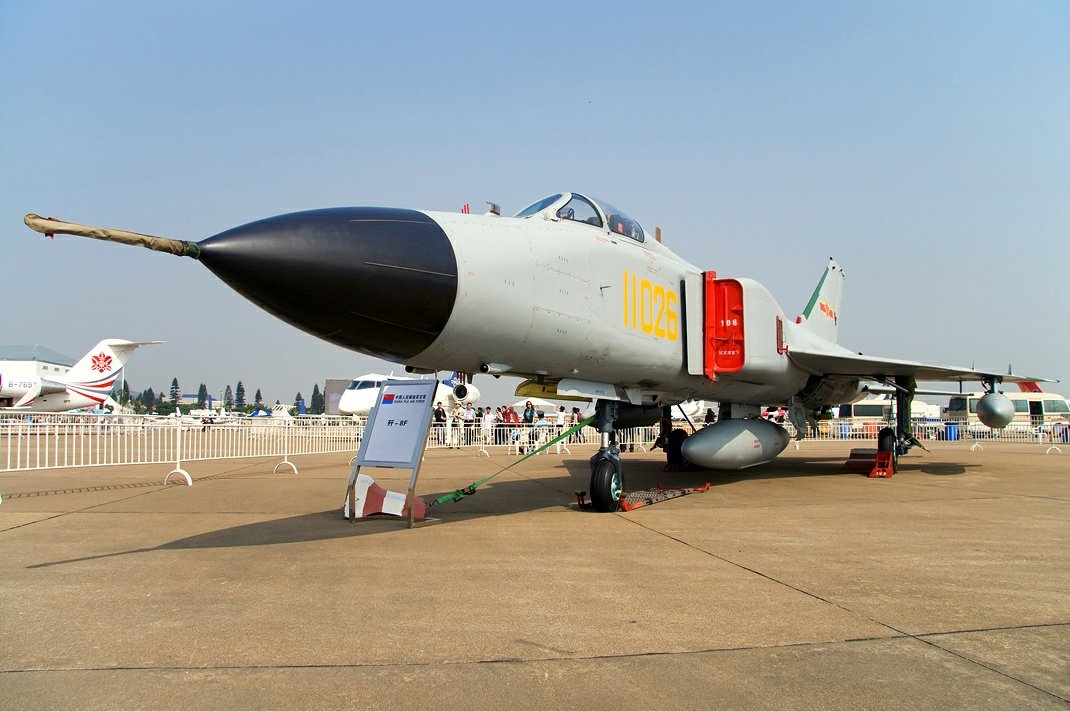 The last of the Finback fighter versions was the J-8F, with Type 1492 pulse-Doppler radar compatible with the advanced PL-12 air-to-air missile., L. G. Liao/Wikimedia Commons“长须鲸”最后一个型号为歼-8F,配备1492型脉冲多普勒雷达,可兼容先进的PL-12空对空导弹。(L. G. Liao / 维基共享资源)
Overall, however, the biggest winner of the collapse of Peace Pearl was the Soviet Union, and later Russia, which stepped in to become China’s top arms supplier. Chinese negotiations to purchase fighters from Moscow began in 1990, with Beijing selecting the Su-27 to become the PLAAF’s first truly modern fighter. China was the first export Flanker customer and secured a license-production deal, and has since produced a plethora of improved indigenous versions .
然而总体来看,“和平珍珠”计划告吹的最大赢家是苏联,以及后来的俄罗斯——它接手成为中国最大的武器供应国。中国从1990年起与莫斯科谈判购买战斗机,北京选择了苏-27作为空军首款真正现代化的战斗机。中国是最早的“侧卫”出口客户,并获得了许可生产协议,此后发展出大量改进的国产型号。
The impressive strides made by China’s aerospace industry in the years since mean the Peace Pearl program is now little remembered. But it’s fascinating to imagine what might have been, had the PLAAF received a technological kickstart of this kind from the United States back in the 1980s. Just the thought of a Shenyang-Grumman fighter is mind-boggling to comprehend today.
中国航空航天工业在随后岁月里取得的惊人进步,意味着“和平珍珠”计划如今已鲜有人忆起。但若设想一下,倘若当年中国空军在1980年代从美国获得过这样一次技术助推,事情本可能如何发展,仍令人玩味。单单是“沈阳-格鲁曼”战斗机这个念头,在今天想来都令人难以思议。
